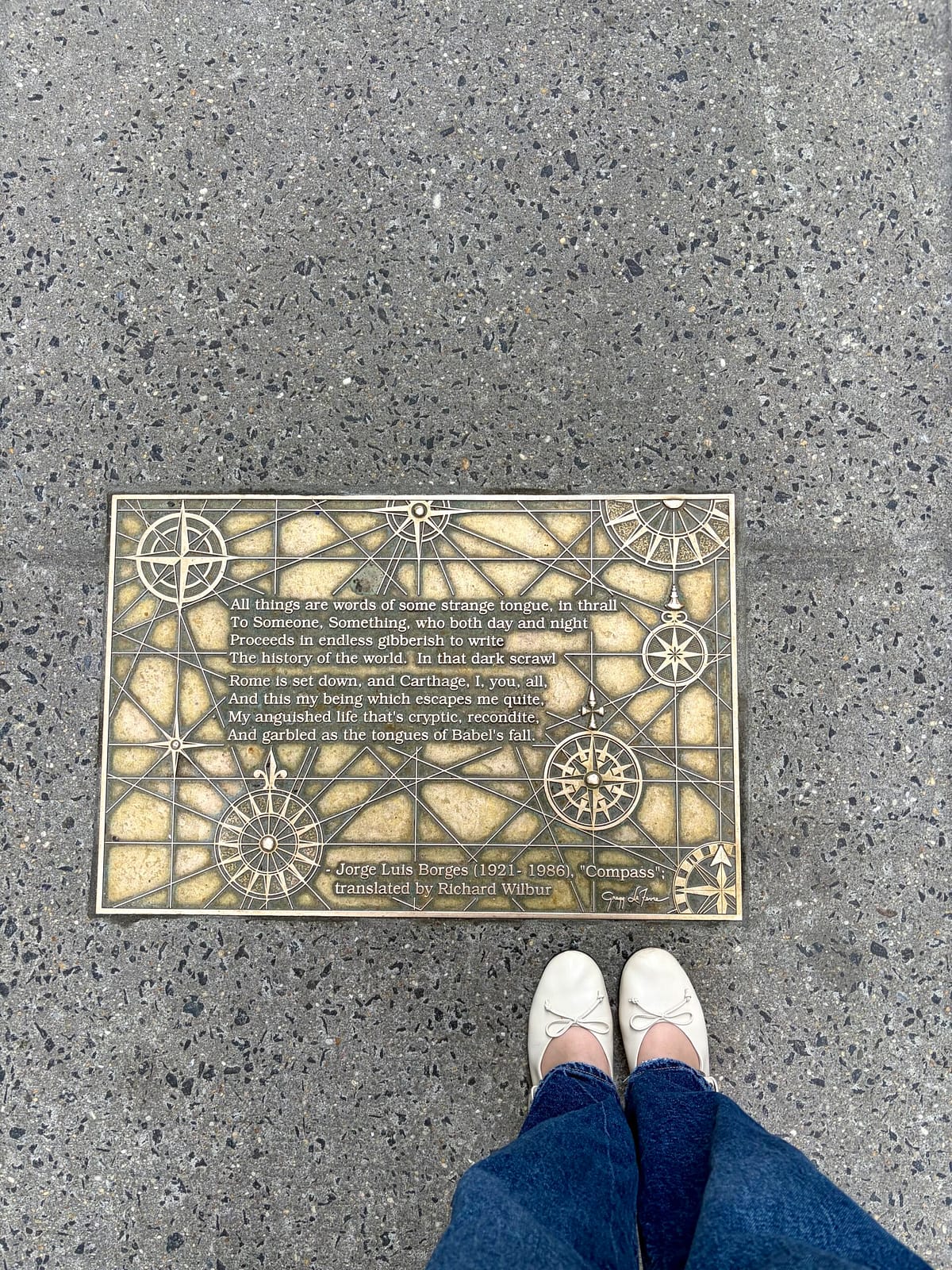
Jorge Luis Borges, usually referred to simply as Borges, was the author who ignited my love for Latin American literature. His short fiction feels tangibly inventive, exploring infinity and identity, reality and fiction, mirrors and labyrinths, and more.
The American school system understandably places greater emphasis on English-language authors, but with the high-quality translations available today, that focus works as a ball and chain to students’ global awareness.
Start your journey into global literature with Borges, as I once did.
The Immortal — a Roman soldier sets off to find the “City of The Immortals”, accidentally achieves immortality, and recounts his experiences passing through history
The Lottery of Babylon — a lottery that starts normal enough but evolves into something with much higher stakes, with the Lottery eventually controlling every aspect of Babylonian life
The House of Asterion — an account of the world through the eyes of the Minotaur
Deutsches Requiem — a former Nazi’s attempt to understand the fate of Germany
Tlön, Uqbar, Orbis Tertius — an encyclopedia entry on a mysterious country that appears not to exist
The Dead Man — an ambitious teenager from Buenos Aires kills a man in a knife fight, escapes to the wild plains of Uruguay, and attempts to become the leader of a gaucho smuggling gang
Pierre Menard, Author of the Quixote — an attempt to write a book that’s already been written — not copy, but literally recreate
The Circular Ruins — a man attempts to dream another man into existence
The Library of Babel — the universe is a library of infinite hexagonal rooms extending in all directions
The Garden of Forking Paths — a German spy is on the run from Allied authorities but before he is captured discovers the truth about his ancestor’s hidden labyrinth
Funes, His Memory — Ireneo Funes, a child who after receiving a bad head injury, acquired the talent (or curse?) of remembering absolutely everything
Three Versions of Judas — fictitious writer Nils Runeberg presents three versions of Judas Iscariot
The Sect of the Phoenix — a secret society that began in ancient times but only performs one ritual; the secret is not shared even with their own children
The Two Kings and The Two Labyrinths — one king humiliates another with an intricate labyrinth; a few years later, the embarrassed king unveils a labyrinth of his own
The South — a librarian idealizes his demise, choosing to die in an “honorable” way
Emma Zunz — a girl who allows herself to be assaulted in order to murder her boss as revenge
The Writing of God — a former priest sits captive in a dark pit with only a wall between him and a jaguar, and he finds the writing of God hidden in its coat
Ibn-Hakam Al-Bokhari, Murderer in His Labyrinth — a mysterious murder of a king, slave, and lion in a labyrinth of his own making
Borges and I — a distinction between the private self versus the public persona